

Accessible Sunshine in La Carihuela
My Spring Escape to La Carihuela, Costa del Sol
April is, quite simply, the sweet spot on Spain's Costa del Sol. Warm enough for long, lazy days outdoors but without the intensity (or crowds) of summer. When I arrived in La Carihuela, the sun was already doing its job - golden, gentle, and reliable - while the evenings cooled just enough to make a light jacket feel like a good idea rather than a necessity. But I wasn't just here just for the sunshine. I wanted to know how accessible La Carihuela really is - and the answer surprised me in a good way.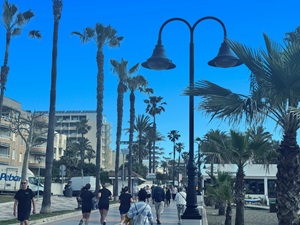
First Impressions: Flat, Friendly, and Full of Life
La Carihuela, once a humble fishing village, still carries that laid-back Andalusian charm. Whitewashed buildings, seafood restaurants spilling onto the pavement, and that unmistakable salty sea air. It feels authentic without trying too hard. What really stood out to me straight away was the promenade. Wide. Flat. Clean. And crucially, easy.
Whether you're walking, rolling, or scooting, this place works with you, not against you. The Paseo Marítimo stretches for kilometres (around seven in total), linking beaches like La Carihuela and El Bajondillo.
Early mornings and sunsets quickly became my favourite times - quiet, soft light, and just enough buzz to remind you you're somewhere special.
Staying by the Sea: The Reality of Accessible Hotels
I stayed at Hotel La Barracuda, right on the beachfront - and location-wise, it’s hard to beat.
The good points for me included: -
- Step-free access throughout
- Lifts everywhere you need them
- Smooth flooring (great for wheels)
- Ramps connecting key areas
- My room even had a proper wet room, with a roll-in shower. Always a big win
But here's the honest bit: I had requested a shower chair, and what I got was a small stool. Usable? Just about. Ideal? Not really. And the mirror? Fixed so high onto the wall, I could just about see the top of my head. That said, this is a common issue, and not just here. It reinforces something I always say: "Be very specific about what you need before you arrive". The pool area is another mixed bag. It looks great, but access is via steps, and there's no hoist.
Eating Out: Where Accessibility Meets Atmosphere
One of my favourite things about La Carihuela? You never have to go far for good food or a sea view. 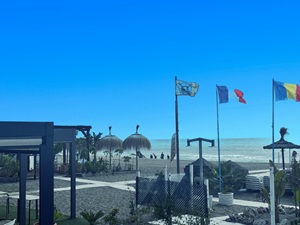
- Step-free entrances or ramps
- Plenty of space between tables
- Accessible toilets (often available)
- Seating right on the promenade
- And matting laid over the sand, to give access to wheelchair users to the beach
Beach Access: Better Than Expected
Access to the beach itself is surprisingly good. Wooden walkways lead down onto the sand at multiple points, and accessible toilets are available - usually managed through the lifeguard stations (just ask for the key). In peak season, you'll also find adapted beach equipment in some areas, making it possible to get even closer to the water.
My Favourite Escape: Parque de la Batería
When I needed a break from the beach (and yes, even I reached that point), I headed to Parque de la Batería. This place is a bit of a hidden gem. Huge, green, and peaceful with proper accessible paths, lifts, and even a bridge linking different levels. The highlight? The lift and walkway to the park from street level. The view across the Mediterranean Sea is vast and immense. It's hard to believe you're still in the middle of a busy coastal town.
Harbour Moments & Holiday Daydreams
At one end of the promenade, near my hotel, you drift naturally into Benalmádena Marina. This quickly became one of my most visited spots. Right by the marina is the Mirador Princess Ferris Wheel. It's smooth, accessible, and surprisingly relaxing. From the top, you get sweeping views of the coastline, which is especially beautiful at sunset. You can also catch a ferry to Fuengirola, a relaxed one-hour trip along the coast. The ferry is just about accessible, with a ramp that is tricky to negotiate in a wheelchair. But the staff - they couldn't have been more helpful.
Fuengirola? Well, the town itself did nothing for me
Yes, there are gift shops and cafes, but ignore those. The real magic is by the water. Sit down in one of the many harbour-side Tapas bars (I liked A La Deriva), order a glass of wine and some tapas and just watch the boats go by. At some point, you'll probably start imagining you own one of the yachts that are docked in the harbour. I certainly did - freshly arrived from Portugal, obviously.
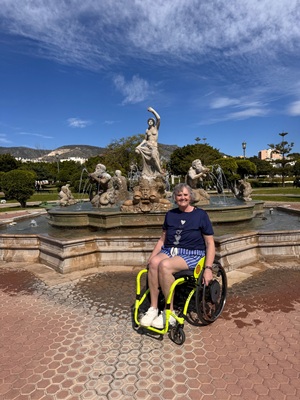
A Note on Torremolinos Town
The beachfront? Brilliant. The town of Torremolinos itself? A bit more challenging. There's a lift advertised from the seafront, but when I visited, it involved steps and a broken platform lift. Not ideal. An accessible taxi solved the problem, though - and it's worth going up into the town for the shops, cafés, and a change of scene.
When You Want More: Málaga in a Day
If you fancy swapping beach life for culture, Málaga is an easy (and worthwhile) day trip - about €35 each way, by accessible taxi. This is the birthplace of Pablo Picasso, and the city has fully embraced its cultural identity.
My highlights: -
- Gibralfaro Castle (not accessible but worth seeing from the square
- The Roman Theatre Málaga
- The cathedral (La Manquita)
- The buzzing Atarazanas Market for a quick vermouth stop
There are also great-value city passes that bundle transport, museums, and tours. Worth considering if you want to see a lot in one go.
Final Thoughts: Would I Go Back?
Absolutely! La Carihuela isn't perfect, but it gets a lot right. It's easy, welcoming, and increasingly accessible without losing its personality.
You've got: -
- Sea views and sunshine
- Properly usable promenades
- Accessible dining locations
- Easy day trips
- And that relaxed Andalusian rhythm
Add in good food, plenty of tapas, and a lively but laid-back atmosphere, and you've got a destination that genuinely works.
For me, it's simple: accessible travel should feel like a holiday, not a compromise. And here, for the most part, it does. Spain is investing heavily in accessibility (over €400 million), and you can really see it here. It's not perfect everywhere, but it's moving in the right direction.